Robot Alley
What if every sidewalk had a hallway underneath it — one built for delivery, mobility, and the city's utilities all at once?
Imagine that underneath every sidewalk was a hallway that:
- Delivery
Allows automated delivery of goods directly to homes and businesses.
- Mobility
Provides freedom of mobility for people who don't drive.
This is a multi-level transportation and utility structure built under sidewalks, alleys, or streets. We call it Robot Alley.
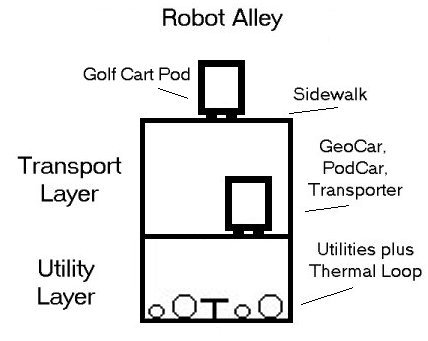
Three Levels, One Structure
What Door-to-Door Delivery Changes
Once automated delivery becomes routine, the effects reach well beyond convenience:
- What's Sold
Shelf space stops limiting what's available locally. Anyone can list goods online and ship them immediately through the City Transport system.
- Delivery Cost
Electric vehicles cut fuel and labor costs down to loading and order processing — with storage handled by easily retrieved containers and essentially unlimited capacity.
- Repair Cost
Central repair locations can receive and return goods far more easily than today's fragmented shipping.
- Disposal
Central disposal routes items to the best possible end-of-life outcome, instead of whatever's most convenient at the curb.
What Runs in the Utility Level
- Main city water — highest quality, for drinking and household use.
- Fire suppression / garden water — lower-quality water for non-potable needs.
- Main electrical supply — the primary power grid connection.
- Backup electrical supply — local generators, at higher cost, for resilience.
- Thermal loop — circulating hot and cold fluid for heating and cooling, a district-scale concept already used worldwide.
Delivery Endpoints
A delivery endpoint could be as small as a dumbwaiter-style lift straight into a kitchen or office — or as large as a direct feed into a room or warehouse. The City Transport System controls every part of that journey: routing, sequencing, and the handoff at the very end.